
ARE YOU 21 OR OLDER?
Continue to the Natural Dos Calm+ CBDA softgel offer.
100-day money-back guarantee · Free US shipping
By entering you accept our Terms of Service and Privacy Policy.


Turn Down The Mental Volume Dial In 30 Minutes.
Dr. Colin Reily PhD reveals 7 reasons people with anxiety and overactive brains are switching to Calm+ CBDA Softgels for day and night relief.
Hemp naturally makes raw CBDA, over 500% better absorbed than CBD, so your nervous system actually absorbs it in minutes instead of passing it through unabsorbed.
100-Day Guarantee · Free Shipping
1Raw, unheated hemp absorbs over 5x better than standard CBD, so you actually feel it in 15 to 30 minutes.
You feel these because your body can actually absorb them.
Almost every hemp softgel on the market is made with standard CBD. Standard CBD is heated during extraction, a process that destroys raw CBDA and leaves behind a degraded compound your digestive tract struggles to take in. Published research shows only 6% of standard oral CBD enters your bloodstream. The other 94% passes straight through.
We skip the heat entirely. Natural Dos preserves raw Natural Spectrum CBDA, which peer-reviewed research shows absorbs over 500% (5X) better than standard CBD. You feel a noticeable softening of tension within 15 to 30 minutes, not weeks later.
2Formulated by a Ph.D. and an M.D. for a precise, measurable dose, with no sugar and no guesswork.
The reason you feel the difference on night one is that every milligram was engineered by scientists, not marketers.
Our co-founders, Dr. Colin Reily, Ph.D. and Dr. Luigi Bertoli, M.D., spent years studying human cannabinoid absorption to build Calm+ on a balanced 1:1 profile:
- 100mg CBDA + 100mg CBD in the standard two-softgel serving (first-time users can start with one)
- Suspended in pure organic MCT oil for rapid cellular uptake
- Clean delivery: zero sugar, zero sweeteners, zero flavorings, zero calories, 100% keto friendly
- Every batch third-party lab tested with an accessible Certificate of Analysis, sealed in amber glass to preserve potency from day 1 to day 60
3Tonight your head hits the pillow, the loop doesn’t start, and the next thing you know it’s morning.
Take your serving with a glass of water 30 to 60 minutes before bed. Within half an hour there is a clean, subtle softening of physical and mental tension, not drowsiness, just quiet.
When your head hits the pillow, the usual replaying-the-day loop doesn’t start. You drift off naturally and you stay asleep straight through the night. Ending the 3am wake-up, where your mind jolts awake in the dark and races about tomorrow, is the #1 outcome customers report.
4Calms the 2pm workday spiral and the 2am sleep spiral by engaging your serotonin pathway.
The racing thoughts that spiral during a tense 2pm workday come from the same biological pathways as the worries that keep you staring at the ceiling at 2am.
While standard CBD mostly interacts with general endocannabinoid receptors, raw CBDA goes a critical step further by acting directly on 5-HT1A serotonin receptors, the primary neurochemical pathway your brain relies on for emotional composure and calm.
- During high-stress afternoons: one softgel turns down the internal volume dial on stress without costing you mental sharpness.
- In the evening: your full two-softgel serving quiets nervous system overdrive so deep sleep takes over naturally.
5Calm without the brain fog: zero THC high, zero melatonin hangover, just a composed version of you.
Most people looking for relief get stuck between two bad alternatives: THC, which leaves you altered or impaired, or melatonin, which forces artificial sedation and leaves a heavy morning hangover.
Calm+ works on an entirely different physiological principle. There is 0.0% THC in the formula, verified by third-party testing on every batch, meaning zero high and zero workplace drug-test concerns. And unlike melatonin, CBDA does not force drowsiness. It simply removes the sharp reactive edge from an overstimulated nervous system. A calmer version of you, not a slower one.
6Unwind after 5pm without the alcohol that fragments your sleep and fogs your morning.
An evening glass of wine feels relaxing at first, but metabolizing alcohol through the night severely fragments REM sleep and triggers an early-morning cortisol spike. That is why one drink to unwind so often leads to waking up parched and anxious at 3am, followed by a sluggish, low-energy morning.
Calm+ provides that same evening transition with zero rebound. Swallowed with water after dinner, your softgels settle physical tension in 15 to 30 minutes without intoxication. You protect your natural sleep architecture and wake up clear-headed.
7Try it for 100 days risk-free: feel the calm and deep rest, or we refund every penny.
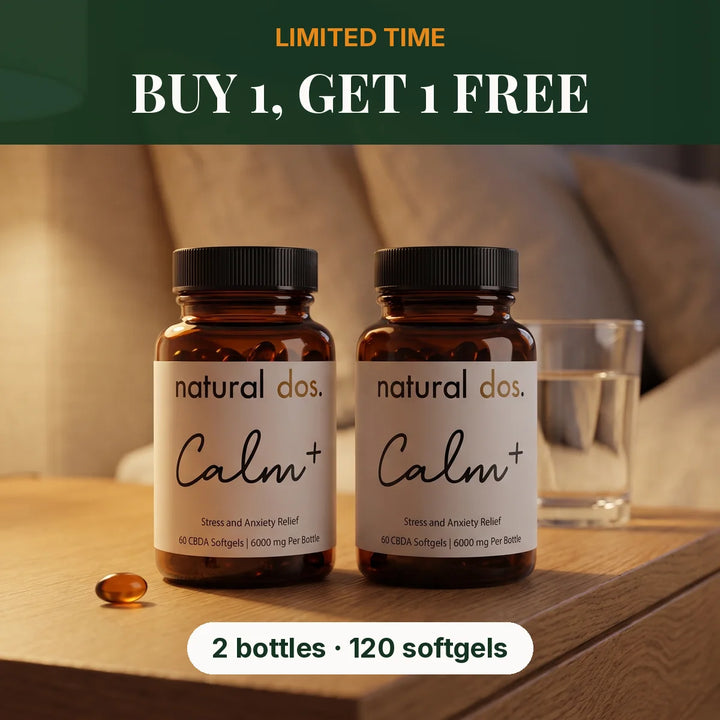
Order the BOGO package today and get two full bottles, 120 softgels, a full 2-month supply at the standard two-a-day serving. Take your serving every evening with water.
If you don’t feel noticeably calmer through high-stress days and sleep dramatically better at night, email us within 100 days. Keep the opened bottle as our gift, return the second bottle on our prepaid label, and we refund 100% of your purchase price.
Don’t just take our word for it
Finally something that works on my nervous system
I have tried virtually every CBD oil and anxiety supplement on the market and never felt a thing. With Calm+ softgels I felt a noticeable physical easing within 25 minutes of taking my serving. My brain stops spinning at night and I fall asleep easily. This is my fourth order.
Lauren M. Verified Buyer
Was skeptical about the science, now convinced
Regular CBD gummies never did anything for me so I almost passed on this. The research on CBDA absorption convinced me to try the BOGO. The difference in how I handle workday pressure is night and day, and my sleep has been the deepest it has been in a decade.
C. F. Verified Buyer
My daily evening ritual. No taste, no sugar
I love that these are clean softgels without sugar or weird gummy flavorings. I take two after dinner with water and by 10pm my mind is quiet. Unlike melatonin, which made me groggy until noon, I wake up sharp and refreshed.
Linda K. Verified Buyer
No more 3am wake-ups staring at the ceiling
For two years I woke up like clockwork at 3:15am with racing thoughts. Taking Calm+ softgels before bed and I sleep straight through until 7am. I didn't believe hemp could work this well until I experienced CBDA.
Marcus T. Verified Buyer
Incredible value on the BOGO package
Two bottles gives you 120 softgels with 6,000mg of cannabinoids in each one, a full two-month supply for the price of a single bottle. Knowing real doctors and biochemists formulated it makes all the difference.
Tom B. Verified Buyer
 Calm
 Sleep
 Zero Sugar
 21+ Adults
Calm+ CBDA Softgels for stress, overthinking & sleep
120 softgels · 100mg CBDA + 100mg CBD per serving
- Quiet the mental loop and end 3am wake-ups
- CBDA, over 5X better absorbed than CBD
- Wake up with zero brain fog
- Calm in 15 to 30 minutes
- Third-party lab tested, 0.0% THC
Natural Spectrum Hemp Extract (raw cannabidiolic acid, CBDA), CBD isolate, organic MCT oil from coconut, bovine gelatin, glycerin, purified water.
- 50mg CBDA per softgel
- 50mg CBD per softgel (further enhances CBDA absorption)
- Standard serving is 2 softgels: 100mg CBDA + 100mg CBD
- 60 softgels per bottle
- 6,000mg total cannabinoids per bottle
- 0.0% Delta-9 THC
Gluten free, non-GMO, zero sugar, zero carbs, keto friendly. No artificial flavors, colors or preservatives.
Every batch is independently tested and certified for potency, purity and safety. We test for heavy metals, pesticides, microbials and residual solvents so what is printed on the label is what is in your bottle. See our Calm+ softgel CoA HERE.
Take 2 softgels with a glass of water 30 to 60 minutes before bed, or 30 to 60 minutes before a stressful situation or a busy afternoon.
First-time users can start with 1 softgel (50mg CBDA + 50mg CBD) to gauge their response. The full serving is 2 softgels.
At 2 softgels daily, your 2-bottle BOGO order is a full 2-month supply. At 1 softgel daily it lasts up to 4 months. Most people feel a calming softening within 15 to 30 minutes, and the balancing effect compounds over 2 to 4 weeks of daily use.
Calm+ softgels are for people who want a clean delivery with nothing extra.
- Zero sugar, zero calories. No cane sugar or tapioca syrup, which matters right before brushing your teeth and for keto diets.
- Double the cannabinoid density. 60 softgels and 6,000mg per bottle, against 3,000mg in a standard 30-count gummy jar.
- Neutral delivery. Odorless and tasteless, encapsulated in organic MCT oil for fast absorption without the chew.
Product not suitable for pregnant or underage individuals.
AS SEEN IN


HONEST ANSWERS
THE QUESTIONS WE GET MOST OFTEN.
What is the difference between CBDA and CBD? +
CBDA is the raw compound living hemp plants actually produce. CBD is what CBDA becomes when it is heated, a process called decarboxylation. Almost every manufacturer applies that heat during processing.
Your body absorbs CBDA over 500% more efficiently than CBD. That is the whole reason most CBD products disappoint people. Not because hemp does not work, but because they are getting the less bioavailable compound.
Calm+ leads with raw CBDA and pairs it with CBD, because CBD further enhances how much of the CBDA your body takes in.
Will Calm+ softgels make me feel high or fail a drug test? +
No. Calm+ softgels contain 0.0% THC, confirmed by third-party lab testing on every batch. No intoxication, no altered state, and no concern on a standard workplace screening.
I have tried CBD before and felt nothing. Why would this be different? +
Because standard oral CBD has a bioavailability of only around 6%. If you swallowed 25mg or 50mg of CBD, your body absorbed a small fraction of it.
Calm+ solves the absorption problem by leading with raw CBDA, which research puts at 5 to 10 times better absorbed. We also pair 50mg CBDA with 50mg CBD in organic MCT oil, which research indicates further boosts cellular uptake.
How quickly does it work, and how long does it last? +
Most people report physical softening, settled breathing and quieter thoughts within 15 to 30 minutes.
The steady release from organic MCT oil gives 6 to 8 hours of support, which is what makes it suited to sleeping through the night. With consistent daily use over 14 to 30 days, CBDA helps regulate your baseline so everyday stressors hit less hard.
How does the 100-day guarantee work with the BOGO package? +
Your purchase is risk-free. When your order arrives, open and use the first bottle for up to 100 days. If you are not satisfied with how you feel during the day or how you sleep at night, email [email protected].
Keep the bottle you opened with our compliments, send back the unopened second bottle on our prepaid return label, and we refund your full purchase price.
Your second bottle is free
Buy one bottle of doctor-formulated Calm+ CBDA softgels, get the second bottle free, with free US shipping and a 100-day money-back guarantee. Quieter evenings and deeper, uninterrupted sleep start tonight.
See full product details →Scientific References
A selection of peer-reviewed research on cannabidiolic acid (CBDA), its pharmacology, its bioavailability, and its mechanisms of action in anxiety, sleep and endocannabinoid pathways.


1. Takeda S, et al. Cannabidiolic acid as a selective cyclooxygenase-2 inhibitory component in cannabis. Drug Metab Dispos. 2008;36(9):1917-21. PMID: 18556441
2. Bolognini D, et al. Cannabidiolic acid prevents vomiting in Suncus murinus and nausea-induced behaviour in rats by enhancing 5-HT1A receptor activation. Br J Pharmacol. 2013;168(6):1456-70. PMID: 23121618
3. Vigli D, et al. Chronic Treatment with Cannabidiolic Acid (CBDA) Reduces Thermal Pain Sensitivity in Male Mice. Neuroscience. 2021;453:113-123. PMID: 33010341
4. Takeda S, et al. Down-regulation of cyclooxygenase-2 (COX-2) by cannabidiolic acid in human breast cancer cells. J Toxicol Sci. 2014;39(5):711-6. PMID: 25242400
5. Ruhaak LR, et al. Evaluation of the cyclooxygenase inhibiting effects of six major cannabinoids. Biol Pharm Bull. 2011;34(5):774-8. PMID: 21532172
6. Formato M, et al. (-)-Cannabidiolic Acid, a Still Overlooked Bioactive Compound. Molecules. 2020;25(11):2638. PMID: 32503116
7. De Gregorio D, et al. Cannabidiol modulates serotonergic transmission and reverses allodynia and anxiety-like behavior. Pain. 2019;160(1):136-150. PMID: 30157131
8. Rock EM, et al. Effect of low doses of cannabidiolic acid and ondansetron on LiCl-induced conditioned gaping. Br J Pharmacol. 2013;169(3):685-92. PMID: 23488964
9. Pertwee RG, et al. Cannabidiolic acid methyl ester produces 5-HT1A receptor-mediated suppression of nausea and anxiety. Br J Pharmacol. 2018;175(1):100-112. PMID: 29044616
10. Resstel LBM, et al. 5-HT1A receptors are involved in cannabidiol-induced attenuation of stress responses. Br J Pharmacol. 2009;156(1):181-8. PMID: 19133999
11. Costa B, et al. Vanilloid TRPV1 receptor mediates the antihyperalgesic effect of cannabidiol in acute inflammation. Br J Pharmacol. 2004;143(2):247-50. PMID: 15313881
12. Starkus J, et al. Diverse TRPV1 responses to cannabinoids. Channels (Austin). 2019;13(1):172-191. PMID: 31088309
13. Wakshlag JJ, et al. Pharmacokinetics of Cannabidiol, Cannabidiolic Acid and Related Metabolites. Front Vet Sci. 2020;7:505. PMID: 33102539
14. Anderson LL, et al. Pharmacokinetics of Phytocannabinoid Acids and Anticonvulsant Effect of Cannabidiolic Acid. J Nat Prod. 2019. doi: 10.1021/acs.jnatprod.9b00600
15. Goerl B, et al. Cannabidiolic acid exhibits entourage-like improvements of anticonvulsant activity. Epilepsy Res. 2021;169:106525. PMID: 33310415
16. Rock EM, et al. Evaluation of CBD, CBDA or CBDA methyl ester on nausea and vomiting. Psychopharmacology. 2020;237(9):2621-2631. PMID: 32488349
17. Aragona F, et al. Role of cannabidiolic acid in pain modulation in horses with chronic osteoarthritis. Front Vet Sci. 2024;11:1496473. PMID: 39720409
18. Kleinhenz MD, et al. Industrial hemp with high CBDA increases lying behavior and reduces stress biomarkers. Sci Rep. 2022;12(1):3683. PMID: 35256692
19. Rock EM, et al. Therapeutic potential of cannabidiol, cannabidiolic acid, and CBDA methyl ester for nausea and vomiting. Cannabis Cannabinoid Res. 2021. doi: 10.1089/can.2021.0041
20. Perucca E, Bialer M. Critical aspects affecting cannabidiol oral bioavailability and metabolic elimination. CNS Drugs. 2020. PMID: 32504402
Natural Dos is not endorsed by, sponsored by, or affiliated with any research institution, journal, or author listed above. References are provided for informational purposes. Individual results may vary.