Are you 21 or older?
The products on this page are intended for adults 21 and over. Please confirm your age to continue.
By entering you accept our Terms of Service and Privacy Policy.


7 reasons anxious overthinkers are switching to this flavorful gummy
CBDA hemp gummies for people who want calm at work and quiet at night, without checking out
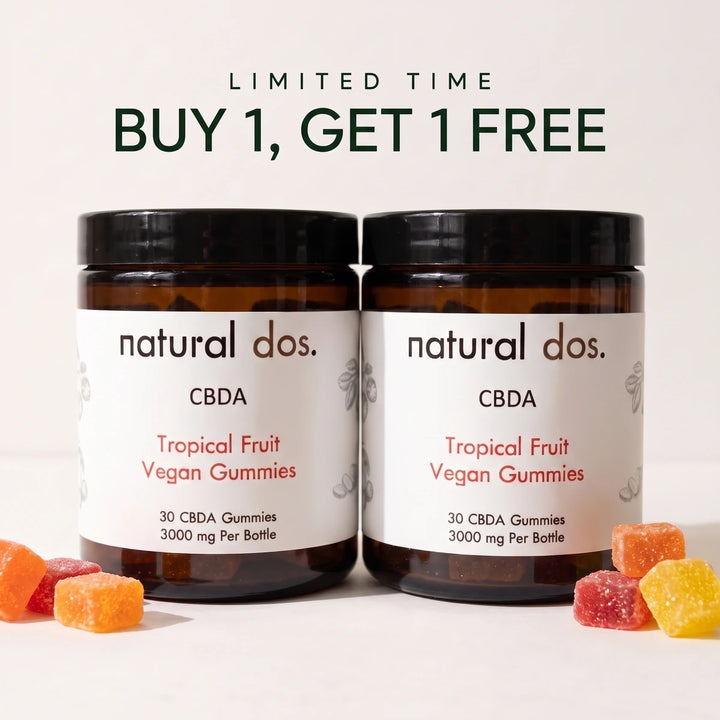
Buy one, get one free100-Day Guarantee
1Raw, unheated hemp absorbs up to 10x better than CBD, so you feel it in 20 minutes, not never.
You feel these because your body can actually absorb them. Almost every hemp gummy is made with CBD, and almost all CBD is made by heating the plant. That heat destroys CBDA, the compound hemp naturally produces, and leaves you with a version your body struggles to take in. Only 6% of CBD is absorbed. That’s why so many people take CBD for months and feel nothing.
We skip the heat. Our gummies are made with raw, never-heated CBDA, which research puts at 5 to 10 times better absorbed than standard CBD.
2Stops the 2pm spiral and the 2am spiral, because it works on the same two systems behind both.
The thoughts that spiral at 2pm are the same thoughts that keep you staring at the ceiling at 2am, and they run on the same two systems in your body. CBDA works on both.
Your endocannabinoid system is the body’s built-in regulator for mood, stress response, and sleep cycles. Your serotonin receptors are the pathway your body relies on for calm and balanced mood. Most hemp only touches the first. CBDA engages the second more directly than CBD does, which is why one gummy at 5pm settles the evening and then carries that same calm into bed.
Two systems. One gummy. The whole day covered.
3Tonight your head hits the pillow, the loop doesn’t start, and the next thing you know it’s morning.
Here’s how the first night usually goes. You take one after dinner. Twenty or thirty minutes later there’s a noticeable softening, not drowsy, just quieter. Your head hits the pillow and the replaying-the-day loop simply doesn’t start. You fall asleep the normal way, and you stay asleep.
The 3am wake-up is the thing people write to us about most. One customer put it simply: “I used to wake up at 3am every night and stare at the ceiling. One gummy before bed and I sleep straight through now.”
4Switch off at 5pm without the wine that wakes you up at 3am and fogs your morning.
Wine works for about an hour, then it turns on you. Alcohol relaxes you on the way down, but it fragments your sleep on the back half of the night, which is why the “one glass to unwind” so often ends in a 3am wake-up and a slow, foggy morning. You end up more anxious the next day, and reaching for the glass again at 5pm.
A tropical CBDA gummy gives you the same 5pm ritual and the same settling of the nerves within half an hour, without the rebound. You stay asleep, you wake up clear, and there’s no THC, no hangover, and nothing that shows up on a drug test.
5Calm without the fog: no THC high, no melatonin hangover, just a quieter version of you.
You stay sharp. That’s the difference between this and the two things people usually compare it to. There’s zero THC in the formula, confirmed by third-party lab testing on every batch, so there’s no high and no altered state. And unlike melatonin, which knocks you out and leaves you dragging the next morning, CBDA doesn’t sedate you. It takes the edge off the anxious mind so sleep can happen on its own.
That’s also why the same gummy works at your desk at 3pm. It’s a calmer version of you, not a slower one.
6Formulated by a Ph.D. and an M.D. so you get the right dose, at the right absorption, without guessing.
The reason you feel these on night one is that the dose wasn’t guessed. Our co-founders, Dr. Colin Reily, Ph.D. and Dr. Luigi Bertoli, M.D., spent years on how CBDA is absorbed and how much of it the body actually needs, then set the 50mg-per-gummy dose from that research rather than from a trend, and paired it with CBD to further enhance absorption.
And what’s on the label is what’s in the jar. Every batch is third-party tested for potency, heavy metals, pesticides, microbials, and residual solvents, and you can read the CoA yourself. We seal them in glass instead of plastic so nothing leaches in and the gummy you take on day 30 is as potent as the one you took on day 1.
7100 days to try it, risk-free. Feel the difference or we refund you.
You have 100 days. Order the gummies, take one at 5pm every day, and see for yourself. If you’re not calmer through the day and sleeping better at night, email us. Keep the jar you opened, send the unopened one back on our prepaid label, and we refund every dollar. No questions.
Right now every jar comes with a second jar free, so you’ll have two full months to find out.
Don’t just take our word for it
Finally something that works
I have tried every calm supplement out there and usually feel nothing. With these I actually relax in about 20 minutes and fall asleep without my mind racing. Three orders in and I am not stopping.
Lauren M. Verified Buyer
Was skeptical, now hooked
CBD never did anything for me so I almost did not try these. So glad I did. The difference in how I handle stressful days is real, and my sleep has been the best it has been in years.
C. F. Verified Buyer
My nightly ritual now
One gummy after dinner and I am calm by the time my head hits the pillow. I wake up clear, not groggy like melatonin made me. The tropical flavor is a nice bonus.
Oskey S. Verified Buyer
No more 3am wakeups
I used to wake up at 3am every night and stare at the ceiling. One gummy before bed and I sleep straight through now. I did not expect it to work this well.
Marcus T. Verified Buyer
Worth every penny
I was nervous about the price until I realized one gummy lasts me the whole evening. It goes a lot further than the cheap CBD I was buying before, and it actually does something.
Priya R. Verified Buyer
 Calm
Calm
 Sleep
Sleep
 Vegan
Vegan
 21+ Adults
Calming CBDA Gummies for stress, anxiety & sleep
2 jars · 60 gummies · 50mg CBDA each
- Vegan tropical fruit flavor: pineapple, sour strawberry, cherry
- Over 5X better absorbed than CBD
- One gummy, 30–60 min before you need it. Calm in about 20 minutes
- Third-party lab tested
- BOGO gets you 60 gummies
Organic tapioca, organic cane sugar, apple pectin, citric acid, natural spectrum CBDA, CBD isolate, natural fruit extract, natural color, sodium citrate, organic coconut oil.
- 50mg CBDA per Gummy
- 50mg CBD per Gummy (further enhances CBDA absorption)
- 30 Tropical Vegan Gummies per bottle
- 3000mg total cannabinoids per Bottle
Every batch is independently tested and scientifically certified for potency, purity, and safety. We test for heavy metals, pesticides, microbials, and residual solvents to ensure you're getting exactly what's on the label — nothing more, nothing less. See our CoA HERE.
Take 1 gummy 30-60 minutes before you need to relax or go to sleep. It's ok to have more than 1! Effects typically begin within 15-30 minutes. Perfect for calm nights, creative projects, improving stress and anxiety during the day, or anytime you need to chill out and still perform.
Smooth, fruity flavor that includes pineapple, sour strawberry or cherry. No harsh aftertaste. The plant-based pectin gelling agent gives it a satisfying, soft chew — crafted with organic cane sugar, natural flavors, and fruit and vegetable juice for color.
What our Natural Dos Ambassadors are saying
Product not suitable for pregnant or underage individuals.
AS SEEN IN


HONEST ANSWERS
THE QUESTIONS WE GET MOST OFTEN.
What's the difference between CBDA and CBD? +
CBDA is the raw compound the hemp plant naturally produces. CBD is what CBDA becomes when it's heated through a process called decarboxylation. Most hemp companies heat their product during purification, converting CBDA into CBD.
Your body absorbs CBDA over 500% more efficiently than CBD. That's the entire reason most CBD products disappoint people, not because hemp doesn't work, but because they're getting the less bioavailable compound.
Our gummies lead with raw CBDA and add CBD alongside it, because CBD further enhances how much of the CBDA your body actually takes in.
Will any of these products make me feel high? +
No. CBDA Vegan Gummies contain zero THC, confirmed by third-party lab testing. No intoxication, no altered state, no drug-test concern.
I've tried CBD before and felt nothing. Why would CBDA be different? +
Because you were taking a compound with dramatically lower bioavailability. If your CBD was made using heat processing (which describes almost all of it), your body was absorbing a fraction of the dose listed on the label. CBDA doesn't have that problem, the absorption advantage is real and measurable. That's why we built the brand around it.
How long does it take to work? +
Stress and anxiety: many customers report noticing a difference within the first 30 minutes, and a few days for energy.
Sleep: most within the first week. Physical ease: tends to build over 2–4 weeks. We say give it 30 days to genuinely evaluate it. That's also why the guarantee is 100 days, you have time to actually know.
Your second jar is free
Buy one jar, get one free, with free shipping on orders over $70 and a 100-day money-back guarantee. Calmer days and quieter nights start tonight.
See full product details →Scientific References
A selection of peer-reviewed research on cannabidiolic acid (CBDA), its pharmacology, and its mechanisms of action in pain, sleep, and inflammation pathways.


1. Takeda S, et al. Cannabidiolic acid as a selective cyclooxygenase-2 inhibitory component in cannabis. Drug Metab Dispos. 2008;36(9):1917-21. PMID: 18556441
2. Bolognini D, et al. Cannabidiolic acid prevents vomiting in Suncus murinus and nausea-induced behaviour in rats by enhancing 5-HT1A receptor activation. Br J Pharmacol. 2013;168(6):1456-70. PMID: 23121618
3. Vigli D, et al. Chronic Treatment with Cannabidiolic Acid (CBDA) Reduces Thermal Pain Sensitivity in Male Mice. Neuroscience. 2021;453:113-123. PMID: 33010341
4. Takeda S, et al. Down-regulation of cyclooxygenase-2 (COX-2) by cannabidiolic acid in human breast cancer cells. J Toxicol Sci. 2014;39(5):711-6. PMID: 25242400
5. Ruhaak LR, et al. Evaluation of the cyclooxygenase inhibiting effects of six major cannabinoids. Biol Pharm Bull. 2011;34(5):774-8. PMID: 21532172
6. Formato M, et al. (-)-Cannabidiolic Acid, a Still Overlooked Bioactive Compound. Molecules. 2020;25(11):2638. PMID: 32503116
7. De Gregorio D, et al. Cannabidiol modulates serotonergic transmission and reverses allodynia and anxiety-like behavior. Pain. 2019;160(1):136-150. PMID: 30157131
8. Rock EM, et al. Effect of low doses of cannabidiolic acid and ondansetron on LiCl-induced conditioned gaping. Br J Pharmacol. 2013;169(3):685-92. PMID: 23488964
9. Pertwee RG, et al. Cannabidiolic acid methyl ester produces 5-HT1A receptor-mediated suppression of nausea and anxiety. Br J Pharmacol. 2018;175(1):100-112. PMID: 29044616
10. Resstel LBM, et al. 5-HT1A receptors are involved in cannabidiol-induced attenuation of stress responses. Br J Pharmacol. 2009;156(1):181-8. PMID: 19133999
11. Costa B, et al. Vanilloid TRPV1 receptor mediates the antihyperalgesic effect of cannabidiol in acute inflammation. Br J Pharmacol. 2004;143(2):247-50. PMID: 15313881
12. Starkus J, et al. Diverse TRPV1 responses to cannabinoids. Channels (Austin). 2019;13(1):172-191. PMID: 31088309
13. Wakshlag JJ, et al. Pharmacokinetics of Cannabidiol, Cannabidiolic Acid and Related Metabolites. Front Vet Sci. 2020;7:505. PMID: 33102539
14. Anderson LL, et al. Pharmacokinetics of Phytocannabinoid Acids and Anticonvulsant Effect of Cannabidiolic Acid. J Nat Prod. 2019. doi: 10.1021/acs.jnatprod.9b00600
15. Goerl B, et al. Cannabidiolic acid exhibits entourage-like improvements of anticonvulsant activity. Epilepsy Res. 2021;169:106525. PMID: 33310415
16. Rock EM, et al. Evaluation of CBD, CBDA or CBDA methyl ester on nausea and vomiting. Psychopharmacology. 2020;237(9):2621-2631. PMID: 32488349
17. Aragona F, et al. Role of cannabidiolic acid in pain modulation in horses with chronic osteoarthritis. Front Vet Sci. 2024;11:1496473. PMID: 39720409
18. Kleinhenz MD, et al. Industrial hemp with high CBDA increases lying behavior and reduces stress biomarkers. Sci Rep. 2022;12(1):3683. PMID: 35256692
19. Rock EM, et al. Therapeutic potential of cannabidiol, cannabidiolic acid, and CBDA methyl ester for nausea and vomiting. Cannabis Cannabinoid Res. 2021. doi: 10.1089/can.2021.0041
20. Perucca E, Bialer M. Critical aspects affecting cannabidiol oral bioavailability and metabolic elimination. CNS Drugs. 2020. PMID: 32504402
Natural Dos is not endorsed by, sponsored by, or affiliated with any research institution, journal, or author listed above. References are provided for informational purposes. Individual results may vary.